International collaboration explores advanced porous materials for energy and environmental applications
April, 20, 2026
A recent publication in Chemical Society Reviews showcases a strong international collaboration between researchers from Europe, the Middle East and Asia, bringing together complementary expertise in chemistry, materials science and energy technologies. The work reflects a collective effort to advance the development of functional porous materials with real-world applications.
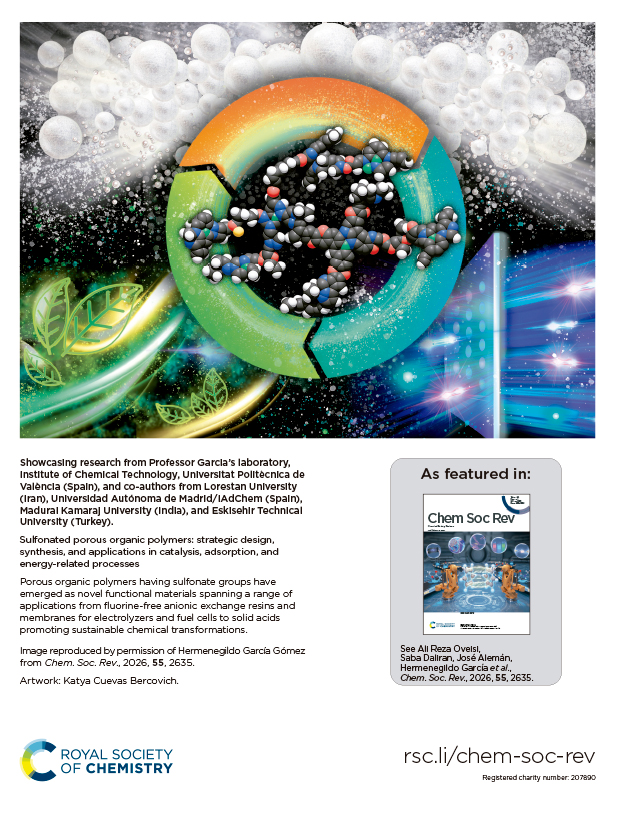
The study focuses on sulfonated porous organic polymers (SPOPs), a class of materials that combines stable porous frameworks with sulfonic acid (–SO₃H) functional groups. This shared research provides a comprehensive overview of their design, synthesis and performance, highlighting how controlled functionalisation can unlock new capabilities across environmental and energy sectors.
The collaboration brings together researchers from multiple institutions, including:
- Ali Reza Oveisi — Lorestan University
- Saba Daliran — Lorestan University
- José Alemán — Universidad Autónoma de Madrid (UAM)
- Matías Blanco — Universidad Autónoma de Madrid (UAM)
- Amarajothi Dhakshinamoorthy — Madurai Kamaraj University (India)
- Unal Sen — Eskisehir Technical University (Turkey)
- Hermenegildo García — HG energy- Instituto de Tecnología Química, Universitat Politècnica de València (Spain)
Together, these institutions form a multidisciplinary network that underlines the importance of collaboration in advancing material science. Their combined work shows that SPOPs are promising candidates for environmental remediation, particularly in removing pollutants such as dyes, antibiotics and heavy metals from water, as well as for selective gas separation processes.
In the energy field, the research highlights their potential as proton-conducting membranes for fuel cells and as components in advanced energy storage systems, offering alternatives to conventional materials and supporting the transition toward more sustainable technologies.
HG Energy recognises the value of this type of collaborative research, where academic institutions and scientific disciplines align to accelerate innovation. The outcomes of this study are closely connected to the group’s interest in integrating advanced materials into future energy and environmental solutions.
This publication also represents a clear opportunity for backover (Artwork: Katya Cuevas), reinforcing the relevance of these materials as a potential pathway for future development and integration into next-generation energy and environmental technologies.
More information about the study is available here:
https://pubs.rsc.org/en/content/articlelanding/2026/cs/d5cs00918a
https://pubs.rsc.org/en/content/articlelanding/2026/cs/d5cs00918a